
Ask ten agents why they stopped posting and nine will give you the same answer: they ran out of ideas. Not time, not budget — ideas. Monday's listing post was easy. By Thursday they were staring at the app with nothing to say, so they said nothing, and the account went dark for three weeks.
The fix is not more creativity. It is a system that removes the decision entirely. When you know that Tuesday is always education and Thursday is always community, you never face a blank feed — you just fill a slot. This post gives you that system: a five-slot weekly framework, a fully worked example week, a way to layer in seasonal themes, and a method to batch the whole month in one sitting. The calendar is one part of a larger system; the real estate social media marketing guide covers the platforms, content types and advertising rules around it.
Consistency beats brilliance
Here is the uncomfortable truth about social media for agents: the person who posts five decent things a week will out-perform the person who posts one brilliant thing a month. Every time.
The algorithm rewards regularity — accounts that show up predictably get shown more. Your audience rewards it too. Buyers and sellers do not hire the agent with the single viral video; they hire the agent whose name they have seen twelve times this month, so that when it is finally time to sell, yours is the only name that comes to mind. Familiarity is the whole game, and familiarity is built from frequency, not fireworks.
There is a hidden benefit, too: a calendar kills the guilt loop. Agents who post ad hoc carry a constant low-grade "I should post something" anxiety that makes every open house feel like a missed content opportunity. Agents with a calendar know exactly what is going out this week, because it is already scheduled. The mental space that frees up is worth as much as the reach.
So stop trying to make every post perfect. Aim for a steady rhythm you can actually keep. A calendar is what turns "I should post more" into "it's Wednesday, so I post the market fact."
The five-slot weekly framework
Five posts a week, five fixed jobs. You are not inventing content — you are filling categories.
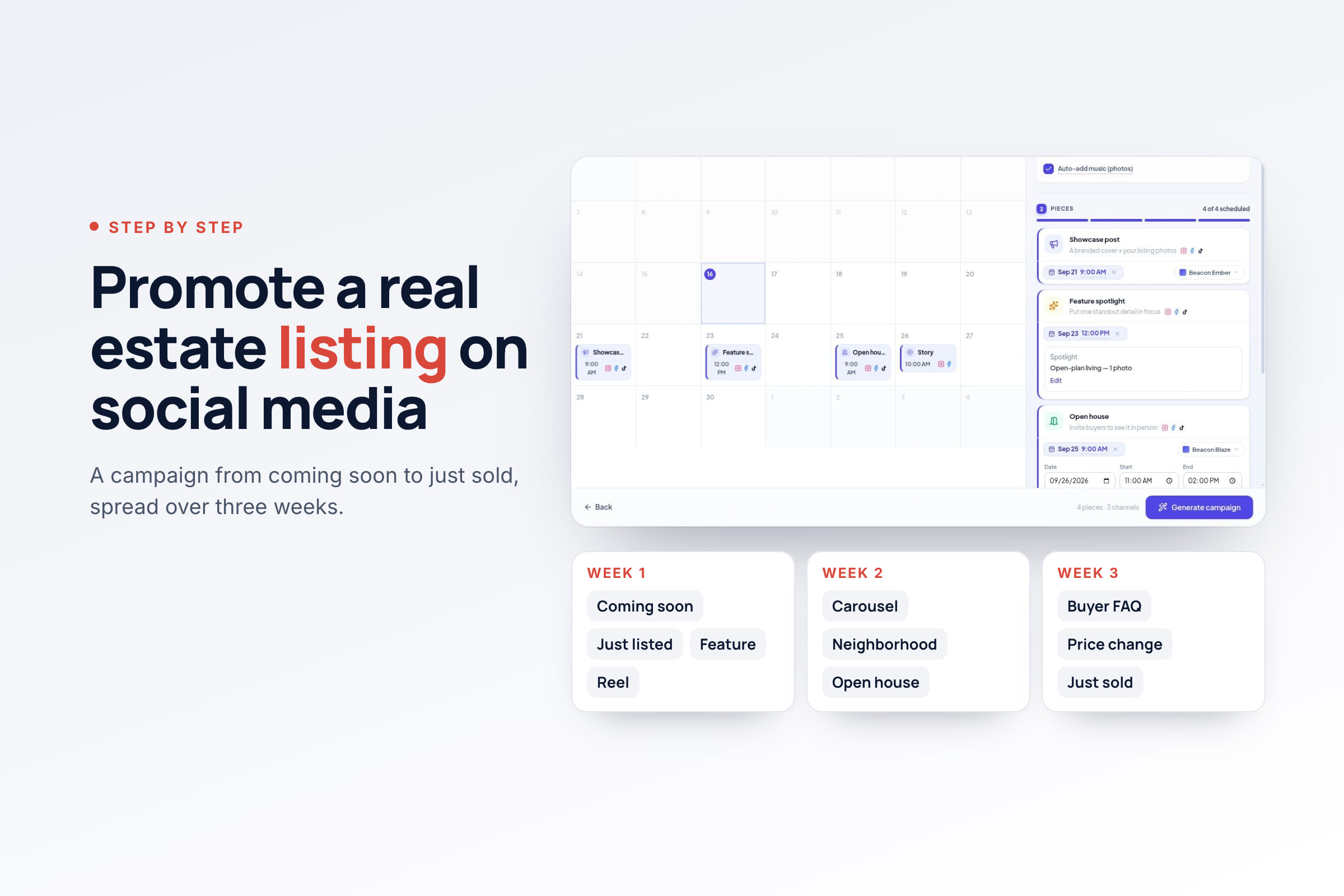
Two listing posts. This is your product. New listings, price changes, open-house invites, just-sold results, or a fresh angle on a property that is still available — the run of posts a single property earns when you promote a real estate listing on social media as a campaign rather than a one-off announcement. Two a week keeps your inventory in front of people without turning your feed into a catalog. No new inventory this week? Revisit a live listing from a new angle — the neighborhood, a single feature, the honest answer to the question every viewer asks about it.
One education post. Teach something. How the offer process works, what a home inspection actually checks, how to read a floor plan, why the asking price is not the sale price. Education posts get saved and shared, and they position you as the expert rather than the salesperson.
One local or community post. Sell the area, not the house. A new restaurant opening, a park you love, a school catchment explainer, a local market trend. This content reaches people who are not buying yet but live nearby — future sellers, all of them.
One personal or brand post. Show the human. A behind-the-scenes clip, a client thank-you, why you got into property, a small win from your week. People instruct people, not logos. This is the slot that builds the relationship the other four cash in.
Two, one, one, one. Learn the shape and you will never wonder what to post again. To fill each slot, pick from our 50 real estate social media post ideas.
The slots also map cleanly onto platforms, so one week of content covers every channel without extra work. Listing posts go everywhere — Instagram, Facebook, LinkedIn, TikTok. Education plays best on Instagram and LinkedIn, where saves and reshares live. Local content is strongest on Instagram, Facebook, and TikTok, where neighbors actually scroll. Personal posts belong on Instagram and Facebook, with the occasional professional milestone on LinkedIn. Same five pieces, tuned per channel — not five separate strategies.
A filled-in example week
Here is the framework turned into a real Monday-to-Friday, for an agent working a mixed market.
Monday — Listing. "Just listed in Toronto's Leslieville — a two-bed loft with exposed brick and a rooftop that catches the skyline. Full tour dropping Wednesday." Start the week with your strongest inventory.
Tuesday — Education. "The three numbers every buyer confuses: asking price, offer price, and closing costs. Here is what each one actually means for your budget." A simple carousel, one number per slide.
Wednesday — Listing. The Leslieville tour you teased on Monday — a fifteen-second reel walking through the loft, address and price on screen. Teasing then delivering trains your audience to watch for your posts.
Thursday — Local. "Three coffee spots within a five-minute walk of that Leslieville loft — because a neighborhood is a lifestyle, not a ZIP code." Ties back to Monday's listing without being a listing post.
Friday — Personal. "Handed over the keys to first-time buyers in Sydney this morning. Six months of searching, one very happy couple. This is the part of the job that never gets old." End the week human.
Notice how the week hangs together. The listing threads through Monday, Wednesday, and Thursday, so a single property does three jobs. The education and personal posts give your feed range so it never feels like a sales channel. That is five posts, one clear story, zero decision fatigue.
Weekends are optional, and that is deliberate — the framework has to survive your busiest open-house season. If you have energy to spare, a Saturday story from the open house or a Sunday poll is a bonus, not a slot you owe anyone.
What about posting times?
The honest answer: timing matters far less than agents think, and consistency matters far more. A good post published at a mediocre time will still travel; a great post that never got made because you missed "the perfect window" reaches nobody.
The practical rule is simply to post when your audience is awake and scrolling — mornings and evenings local time for consumer content, weekday mornings for LinkedIn — and to let a real estate social media scheduler hit those windows for you. Once posts go out automatically at a sensible hour, the timing question disappears entirely, which is the real win: it removes one more reason to not post. If you want the data behind the windows, our guide to the best time to post on social media for real estate compares the 2026 studies.
Monthly themes and seasonality
The weekly framework is your skeleton. Themes give it a spine across the year, so your content tracks what buyers and sellers are actually thinking about.
Think in seasons, not scattered posts. January is planning season — "thinking of selling this year? Here is what to fix first." Spring is peak listing season in most markets, so lean into fresh-to-market energy and curb appeal. Summer splits by climate: pool-and-terrace lifestyle content in Dubai or Sydney, "beat the fall rush" urgency in London or Toronto. Fall is the serious-buyer window before year-end. December is quiet on transactions but perfect for year-in-review and community warmth.
Layer a light monthly theme over the five slots and your education and local posts practically write themselves. A "first-time buyer" theme month means every Tuesday education slot ladders up to one story, and by month's end you have taught a complete beginner's guide without ever planning it as one.
Do not over-engineer this. One theme a month, loosely applied, is plenty. The slots carry the consistency; the theme just points them in a direction.
How to batch it in one sitting
The calendar only works if filling it is faster than agonizing over it. Batch a whole week — or a whole month — in a single session.
Block ninety minutes and run it as four passes:
Minutes 0 to 15 — lay out the slots. Open the calendar and place the empty slots for the period: two listing, one education, one local, one personal, per week. Decide which listing anchors each week. No writing yet — just structure.
Minutes 15 to 50 — draft by category, not by day. Write all the listing captions first while you are in listing headspace, then the education posts, then local, then personal. Category batching keeps your brain in one mode and is dramatically faster than hopping between mindsets day by day. Lean on the tools here: feed a listing to the AI for your property captions in your brand voice, and ask the AI Agent to plan the education and local slots around the month's theme so you are editing suggestions instead of inventing from zero.
Minutes 50 to 70 — build the visuals. Auto-fill any carousels or flyers from the listing in Design Studio, and queue the reels to render in the background while you keep working. Visuals in one pass, same as the words — which is what a content creation tool built around your listings is really buying you.
Minutes 70 to 90 — schedule and tune. Drop everything onto the content calendar — Instagram, Facebook, and TikTok in a single view. Set per-channel captions where a platform wants a different tone, add a first comment for hashtags or extra detail, and space it all out. Close the laptop with the whole period done. Our real estate social media automation guide shows how to cross-post and queue a batch like this.
Then add one small habit: a fifteen-minute review at the end of each month. Look at which posts earned saves, comments, and DMs — not just views — and let the winners shape next month's slots. If neighborhood content keeps out-performing, your local slot earns a second day. If a format has been dead for two months, retire it without ceremony. The calendar stays the same shape; the content inside it slowly gets sharper.
That is the whole point of a calendar. It is not busywork — it is the thing that lets you be consistent without being chained to your phone. Decide once, batch once, show up every day.
Ready to stop staring at a blank feed? Get started and fill a month of slots in one sitting.