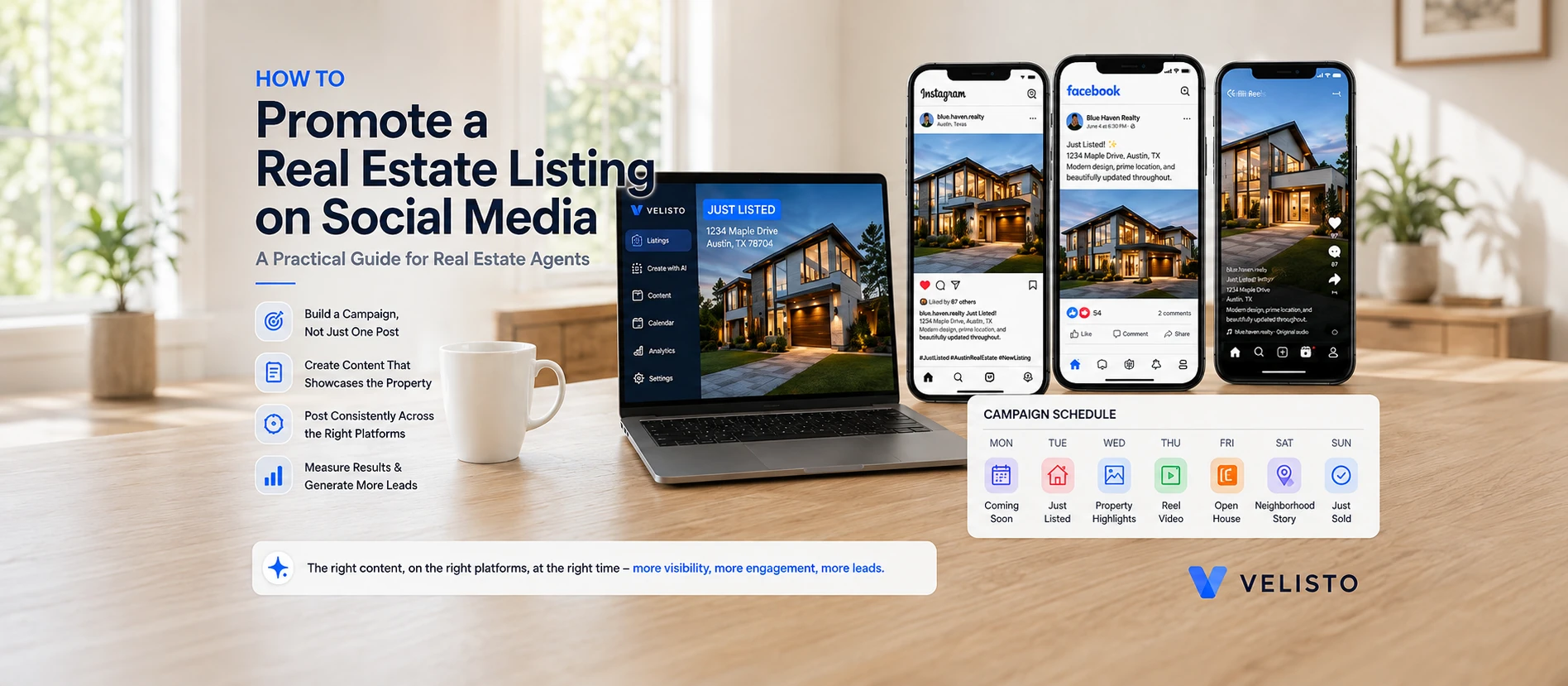
Most listings get one post. It goes up the day the property hits the MLS, it says "Just Listed" over a photo of the front elevation, it collects a dozen likes from other agents, and that is the entire marketing plan. Two weeks later the property is still on the market and the feed has moved on.
The problem is not the post. It is that a single post asks one piece of content to do the job of a campaign. A property has more than one thing to say about it, reaches more than one kind of buyer, and stays on the market far longer than a post stays in anyone's feed. Treat the listing as a small campaign — eight to twelve pieces spread over two or three weeks, each with its own angle and job — and the same property earns weeks of attention instead of an afternoon.
Here is the process: find the angle, build the campaign, pick the formats, adapt per network, write captions that do work, schedule it sensibly, and read the numbers that actually matter. For how listing campaigns fit into the rest of your plan, see the 2026 guide to real estate social media marketing.
Start with the listing's strongest marketing angle
Before you write anything, decide what this property is actually selling. Every listing has one angle that is stronger than the rest, and picking it first saves you from the generic post that could describe any home in your market.
The strongest visual. Go through the photographs and find the one shot that would make a stranger stop scrolling. Sometimes it is the view, sometimes the kitchen, sometimes a staircase or a bath positioned under a window. That image is your lead, and everything else in the campaign supports it. If no photograph in the set does that job, the honest answer is that you have a photography problem, not a social media problem.
The buyer type. A two-bed condo with a home office near the train sells to a different person than a five-bed with a backyard near a school. Naming that buyer changes the language, the details you lead with, and the platform that makes sense. Write down who this home is for in one sentence before you write a caption. Use it to choose the angle, not as caption copy: the caption describes the home, never the buyer, as Fair Housing rules require.
The location and lifestyle. For anyone moving into an area rather than within it, the neighborhood is half the purchase. The walk to the train, the coffee shop on the corner, the park two streets over — this is the angle that reaches people who are researching a neighborhood long before they are booking showings.
The standout feature. One specific, unusual thing: the workshop, the wine cellar, the south-facing deck, the studio at the back of the yard. Specific beats impressive. "Four bedrooms" is a spec; "a backyard studio with power and heating, so it works as an office in January" is a reason to save the post.
The price and value angle. Where it applies, price is a legitimate hook — the best value on the street, a recent reduction, more space for the money than the next ZIP code over. Handle it factually and without hype, and it does a lot of work with buyers who are actively comparing.
You are not choosing one of these and discarding the rest. You are deciding which one leads, because the lead angle determines the first post, and the rest become later pieces in the campaign.
Build a campaign instead of one post
A listing has a life: it comes to market, it is new, it gets viewed, the price may move, it sells. Each of those moments is a reason to post that does not feel like repeating yourself, which is the whole trick — you are not posting the same property ten times, you are posting ten different things that happen to concern the same property.
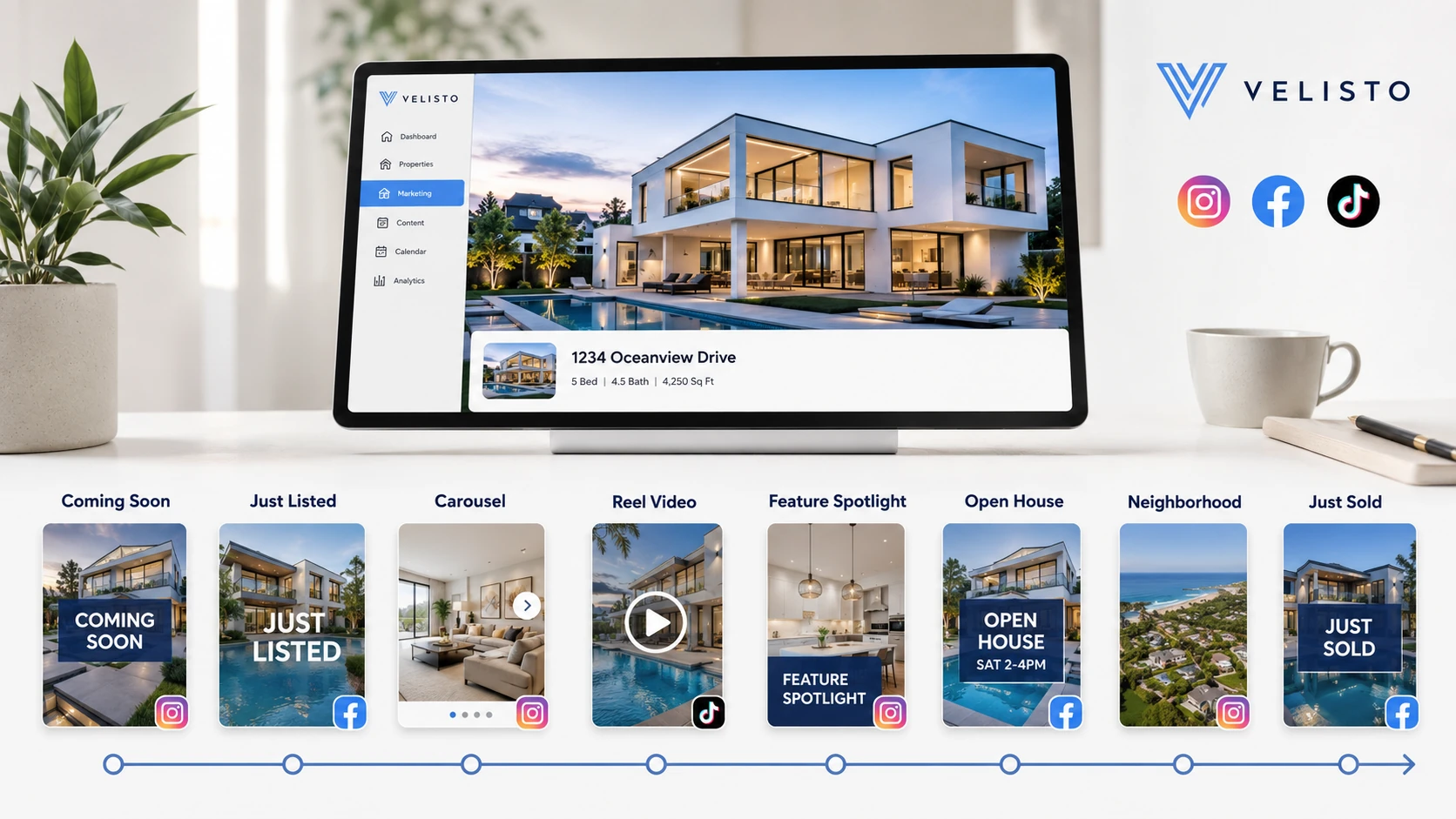
The stages worth planning around:
- Coming soon. A teaser before the listing goes live — one detail, no address, no full gallery. It builds a small amount of anticipation and, more practically, it gives you a post on a day when you would otherwise have nothing.
- Just listed. The announcement, built on your strongest visual and the buyer you identified.
- Feature spotlight. One room, one detail, one thing the tour glosses over. This is where the standout feature earns its own post.
- Property carousel. The considered walk-through for people who want to see more than one frame before they commit to inquiring.
- Listing reel or vertical video. The format that reaches beyond your existing followers.
- Neighborhood and lifestyle. No interiors. The area, the amenities, the commute — aimed at the buyer who is choosing a location as much as a house.
- Open house. An invitation, posted with enough notice to be actionable, then a reminder the day before.
- Buyer FAQ. The three questions you actually get asked about this property — HOA fees, parking, when the sellers can move out. Answering them publicly saves you repeating yourself in DMs and signals that you are straightforward.
- Price change, where relevant. A reduction is news. Framed plainly — not apologetically — it reaches everyone who liked the property but hesitated.
- Just sold. The result. This one is not marketing the property at all; it is marketing you to the next seller watching.
That is ten distinct pieces from one property without a single duplicate. If you want the underlying framework in more depth — the full repeatable system for getting ten pieces out of one property — turn one listing into ten posts walks through it format by format.
Not every listing needs all ten. A property that sells in nine days gets the first four and then jumps to Just Sold. The point is to have the sequence ready so that "what do I post about this house today?" is never a question you answer from scratch.
Choose the right content format
The angle decides what you say. The format decides whether anyone sees it.
Single-image posts are for a moment with one clear message: the announcement, the price change, the open house invitation, the sold card. They are quick to make and quick to read, and that is the entire argument for them. They mostly reach people who already follow you, so use them for announcements rather than for reach.
Carousels suit anything with a sequence or a comparison — a room-by-room walk-through, before-and-after staging, three reasons this street is worth the premium, a buyer FAQ where each slide answers one question. They ask for more attention than a single image and reward you when someone gives it, because a carousel that is worth swiping is usually worth saving.
Stories are the low-stakes format. Open house reminders, a quick clip from a showing, a poll about which kitchen finish people prefer, a countdown to a launch. Nothing here needs to be polished, and none of it clutters your grid, which is exactly why it is the right home for the day-to-day updates that would otherwise be too minor to post.
Reels and vertical video are how a listing reaches people who do not follow you. A tour, a single-feature clip, a walk from the front door to the terrace. Keep it short and vertical, lead with your best shot rather than building to it, and put the address and price on screen — most people watch without sound.
Text and educational posts carry no property at all: how the offer process works, what a home inspection actually covers, why a property three streets over sold for more. This is the content that keeps your feed useful between listings, and it is what makes a follower stay when they are twelve months away from moving.
A good campaign mixes all five. If every piece is a single image of the front of the house, you have made one post five times.
Adapt the listing for each social network
The same campaign runs differently on each platform. The assets carry over; the framing does not.
Instagram is where the property looks its best and where most agents' audiences already live. Reels are the pieces that travel beyond your followers, carousels are what serious buyers save, and Stories carry the running commentary — the open house reminder, the "we have an offer" update, the poll.
Keep the grid coherent: consistent colors, consistent overlay style, your logo somewhere on every design. When a post gets reshared into someone's Story, the branding is the only thing tying that reach back to you. Put the address and price on screen in any video, and lead the caption with something the images did not already say. If you want the wider channel playbook rather than the listing-level version, Instagram for real estate agents covers how the formats divide the work across a whole account.
Facebook rewards a longer, warmer caption than Instagram tolerates, and it is still where local community reach lives. The full story of a property — its history, the renovation, why the sellers are moving — lands here in a way it does not on a visual-first feed.
The open house invitation is the piece that performs best on Facebook, because the audience is more local and more likely to know someone who is looking. Multi-photo posts work well; so does sharing the listing into relevant local groups where that is permitted, which is a distribution channel Instagram has no equivalent for. Facebook for real estate agents goes deeper on the Page-level strategy.
TikTok
TikTok is discovery-led rather than follower-led, which makes it the platform where a new account can still reach local buyers quickly. The tone is the thing most agents get wrong: a polished ad underperforms a phone held at arm's length and an honest "you have to see this kitchen."
The vertical video you made for reels usually works here with a looser caption and a different hook — but export a clean file and upload it natively rather than reposting a version with another platform's watermark burned in. Beyond listings, the budget and neighborhood formats do a lot of work: what a given price actually buys in your city, or an honest tour of an area. TikTok for real estate agents has the detail.
LinkedIn is worth a mention as a fourth channel, particularly for referral-driven business — relocating professionals, brokers and agents in other markets. A market-update or case-study document carousel posted natively is the format that works there. Velisto does not publish to LinkedIn today; the integration is built and awaiting LinkedIn's approval, so for now it stays a manual channel.
Write captions that actually help sell the listing
A caption has five jobs, and most listing captions do one of them.
Open with a hook, not a label. "Just listed" is a category, not an opening line. "The terrace faces west, so every evening looks like this" gives someone a reason to keep reading. Lead with the most interesting true thing about the property.
Give the details buyers actually need. Beds, baths, the area, the price or the reason there isn't one, and anything material — the HOA fees, the parking situation, any rental restrictions. Withholding basics to force a DM annoys serious buyers and filters out exactly the ones who were ready to act.
Add the context the photographs cannot carry. Which way the backyard faces. How long the walk to the train really is. That the third bedroom fits a queen bed, not just a desk. This is where local expertise shows, and it is the part a competitor cannot copy from your gallery.
End with one clear next step. "DM to schedule a showing." "Open house Saturday, 11 to 1." "Link in bio for the full listing." One instruction, not three.
Match the platform's tone. The same property warrants a tighter caption on Instagram, a fuller one on Facebook, and a looser, more spoken one on TikTok. Write the caption once and tune it per channel rather than writing four from scratch.
On AI-assisted copy: it is genuinely useful for a first draft and hopeless as a final one. The tell is always the same — adjectives with no specifics behind them. "Stunning," "nestled," "boasting," "a rare opportunity." Any sentence that would survive being pasted onto a different property is a sentence that is not doing anything. Cut it and put a fact in its place.
Create a posting schedule around the property
Ten pieces posted on ten consecutive days is a campaign that reads as spam. The same ten spread across two or three weeks reads as a property with momentum. Here is a realistic shape for a listing that comes to market on a Monday, mixed with the rest of your content rather than replacing it.
| Week | Days | Pieces |
|---|---|---|
| Week 1 | Day 1 (pre-launch) | Coming soon teaser — Story plus one feed post, one detail only |
| Day 3 | Just Listed announcement — lead image, full caption | |
| Day 5 | Feature spotlight — the standout room or detail | |
| Day 6–7 | Listing reel — the vertical tour | |
| Week 2 | Day 9 | Property carousel — the room-by-room walk-through |
| Day 11 | Neighborhood or lifestyle post — no interiors | |
| Day 12–13 | Open house invitation, plus a Story reminder the day before | |
| Week 3 | Day 16 | Buyer FAQ — the three questions you keep being asked |
| Day 18 | Second angle on the strongest feature, in a different format | |
| Day 20+ | Price change if relevant, then Just Sold when it lands |
Two things make this work. The property appears roughly every other day rather than daily, and the gaps are filled with content that has nothing to do with this listing — education, local posts, something personal. If a listing is the only thing on your feed for three weeks, the feed becomes a shop window rather than a reason to follow you.
For the wider question of what fills the days between listing posts, the real-estate social media calendar sets out a weekly framework you can run permanently.
Reuse the listing without making the feed repetitive
Repetition is not caused by posting the same property twice. It is caused by posting the same piece twice. Change any one of three things and the post reads as new.
Change the angle. The kitchen post and the backyard post are the same house and different content. So are "what $400k buys on this street" and "this house has a heated backyard studio."
Change the format. A carousel of the same five rooms is a different experience from a reel of them. A photograph of the terrace and a fifteen-second clip of the terrace at golden hour are not the same post.
Change the purpose. An announcement, an invitation, an explanation and a result are four different jobs. The Just Sold post uses the same photographs as the Just Listed post and communicates something entirely different.
The failure mode to avoid is posting the identical hero image with a slightly reworded caption. That is the version people notice, and it is the one that costs you followers.
Measure what worked
Views are the least useful number on the page. They tell you how many people the platform showed something to, which is a fact about distribution rather than about your property. These are the metrics that track back to business.
Reach, specifically the split between followers and non-followers. Non-follower reach is the number that tells you a piece traveled beyond the audience you already had.
Saves. Someone saving a listing post is the strongest passive signal available: they are keeping it to come back to, which usually means they are considering it or sending it to whoever they are buying with.
Shares. A share is a recommendation. On local content in particular, shares are how a post reaches the neighbor who knows the buyer.
Profile visits. Someone watched a piece and went looking for who made it. That is the step immediately before an inquiry, and it is the clearest evidence that a video did its job.
Inquiries and DMs. The only metric that pays. Track which piece prompted them — it is almost never the announcement, and often the FAQ or the neighborhood post.
Listing or link views, where the platform gives them to you. Traffic from social to the actual property page is the closest thing to intent you can measure.
After two or three listings you will see a pattern: a format that consistently earns saves, an angle that consistently earns DMs. Move budget and effort toward those and stop making the pieces that only ever collect likes.
How Velisto can automate the workflow
This process works whether or not you use software. What software removes is the retyping.
Velisto starts from the listing itself — synced from a Houzez WordPress site, imported from a CSV or a listing URL, or entered manually — so the photos, price, bedrooms, address and description are already in place. From that data it can generate AI captions in your brand voice, with a separate caption variant per channel on a single post; branded designs and multi-slide carousels in Design Studio, auto-filled from your brand kit and the property's own photographs; and 9:16 listing reels rendered in the background from those photos, with a branded price-and-address overlay.
Listing campaigns do the campaign assembly described above in one step: pick the property, the photos and the angle, and the kit produces a coordinated set of pieces — showcase post, feature spotlight, open house invite, Story, reel — which you drag onto calendar days or auto-schedule. Everything lands on one real estate social media scheduler with queues, drafts and per-channel captions, and analytics come back as reach, engagement and follower growth per channel plus per-post stats.
Velisto currently publishes directly to Instagram, Facebook, TikTok and Threads. LinkedIn and YouTube are built and awaiting platform approval. It is not an ads manager, so paid promotion stays in Meta Ads Manager or TikTok Ads Manager.
FAQ
How many posts should one property listing get? Around eight to twelve pieces spread over two to three weeks is a realistic target for a normal listing. Fewer than five and the property barely registers; more than a dozen in a short window and your feed becomes an ad for one house. A property that sells quickly simply gets the early pieces and then the Just Sold post.
How long should I keep promoting a listing on social media? For as long as it is genuinely news, which is usually two to three weeks from launch, plus a post whenever something changes — an open house, a price adjustment, a sale agreed. Once you are posting about a property with nothing new to say, you are padding, and the audience can tell.
Which social network is best for promoting a property listing? It depends on the buyer. Instagram is the strongest all-rounder for visual property content, Facebook reaches a more local audience and is the best place for open house invitations and community groups, and TikTok reaches people who do not follow you, which makes it valuable for building an audience from nothing. Most agents get the best return by running Instagram and Facebook properly before adding a third.
Should I pay to boost a listing post? Boost the piece that has already earned organic engagement rather than the announcement. If a reel or a neighborhood post is performing on its own, paid distribution amplifies something that has already proven it works. Boosting a flat post mostly buys you more people ignoring it.
What should I post if the listing photography is weak? Lead with video and detail shots rather than wide room photos, which are the hardest to get right. A vertical walk-through, a close-up of the one genuinely good feature, and neighborhood content will carry a listing further than five mediocre stills. Then have a conversation with the seller about reshooting, because no caption fixes a dark photograph.
Pick your next listing, choose its strongest angle, and plan the campaign before the property goes live. Get started.