
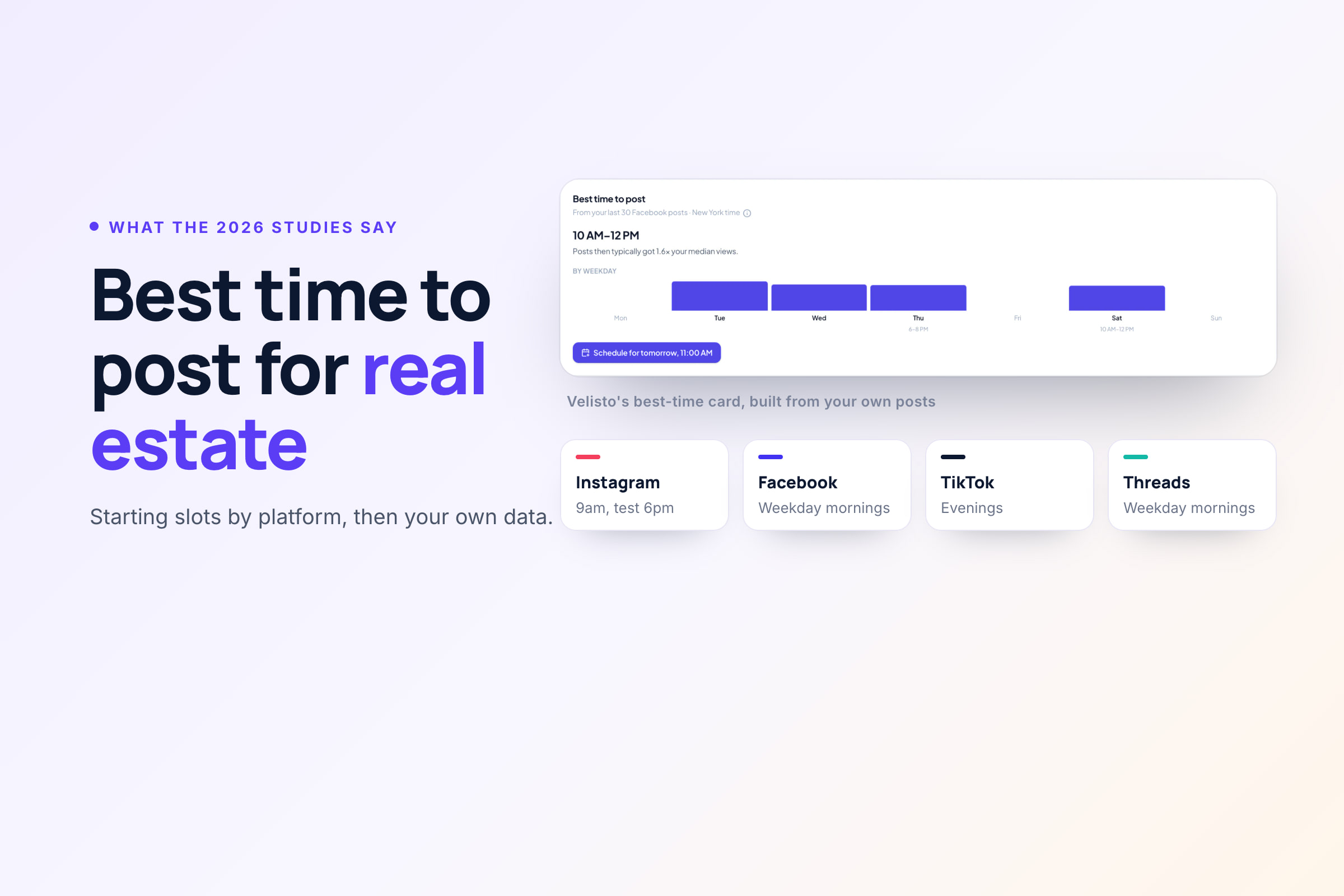
The best time to post on social media for real estate is, as a starting point, weekday mornings around 9 a.m. in your audience's time zone on Instagram, Facebook and Threads, plus an early-evening slot around 6 p.m. for listings, and evenings on TikTok. That's the honest summary of the 2026 data. The less tidy truth is that the big timing studies disagree with each other, none of them has a real estate breakdown, and your own account's numbers will beat any average within a month.
This guide gives you the starting slots platform by platform, shows what each 2026 study found and why they differ, adds what we know about when home buyers actually search, and walks you through a four-week test to find your own best time. The study figures were checked on each publisher's page on September 24, 2026. For what to post, see our real estate social media marketing guide.
Best times to post by platform (2026)
These are our recommended starting slots for real estate agents, built from the studies below. They are where to start testing, not a rule. All times are in your audience's local time.
Start with weekday mornings at 9 a.m., and test 6 p.m. for listings. Buffer's 2026 analysis of 9.6 million Instagram posts found its top slots at 9 a.m. on Thursday, noon on Wednesday and 6 p.m. on Wednesday. Sprout Social's points to Tuesday and Wednesday afternoons. The evening slot matters for listings because that's when buyers are browsing homes (see below).
Start with weekday mornings between 8 a.m. and noon. Buffer puts Facebook's best window at 8 a.m. to noon on weekdays, with Thursday at 9 a.m. the single best slot; Hootsuite also lands on a weekday morning, Tuesday at 9 a.m. Sprout's data disagrees and favors Tuesday and Wednesday from noon to 8 p.m., so if mornings don't work for your audience, afternoons are the next test.
TikTok
Start with early evenings, 6 to 8 p.m. TikTok is where the studies disagree most: Buffer found 6 to 11 p.m. every day plus weekend mornings, Sprout found Tuesday to Friday afternoons from 2 to 6 p.m., and Hootsuite found Thursday mornings. Evenings fit how people use TikTok, but test an afternoon slot early.
Threads
Start with weekday mornings around 8 a.m. Buffer's Threads data points to weekday mornings (its best single slot is Thursday at 9 a.m.), and Hootsuite's to Tuesday at 8 a.m. Threads moves fast, so a morning post that starts a conversation can carry through the day.
What the 2026 studies say, and why they disagree
Every "best time to post" article, including this one, rests on a handful of vendor studies. Here is what the current editions found:
| Study | Data | Period | Time basis | TikTok | Threads | ||
|---|---|---|---|---|---|---|---|
| Sprout Social (March 2026) | ~2 billion engagements, ~307,000 profiles | Nov 2025 to Feb 2026 | Local time | Tue 1–7 p.m., Wed noon–9 p.m. | Tue and Wed noon–8 p.m. | Tue–Fri 2–6 p.m. | Not covered |
| Buffer (March 2026) | 52 million+ posts, 200,000+ accounts | 2024 to 2025 | Local time | Weekdays 9 a.m. and 6 p.m. | Weekdays 8 a.m.–noon | 6–11 p.m. daily, plus weekend mornings | Weekdays 7 a.m.–noon |
| Hootsuite (updated June 2026) | 1 million+ posts | Not stated | "Time-zone agnostic" | Mon 3–9 p.m. | Tue 9 a.m. | Thu 7–11 a.m. | Tue 8 a.m. |
| Later (updated April 2026) | 6 million+ Instagram posts | Jan to Oct 2024 | Audience's local time | Mon 5 a.m. | Not covered | Not covered | Not covered |
Four studies, four different answers for Instagram. They disagree for reasons that have nothing to do with you:
- They measure different things. Sprout reports engagements; the others use their own mix of reach and engagement. None of them measures showings or leads.
- Their samples are different businesses. Brands, creators and agencies all have different audiences, and none of these studies breaks out real estate.
- Their data is from different years. Later's 2026 page uses 2024 data; Hootsuite doesn't state a period.
- They handle time zones differently. Most use local time, Hootsuite normalizes across 118 countries, and older articles often quote Eastern Time without saying so.
What they agree on is broad: weekdays beat weekends, especially for Facebook and Instagram, and the very early hours are weak. Use that, and let your own data do the rest.
When home buyers actually search
The studies tell you when people engage with social media in general. For real estate, it also helps to know when people look at homes. Redfin analyzed searches on its website and app in January and February 2022 and found the peak was Tuesday at 8 p.m., up from Thursday at 8 p.m. before the pandemic, with Friday evening the quietest weeknight. It's the most recent public data of its kind, and it's from 2022, so treat it as a direction rather than a timetable.
The takeaway: buyers browse on weekday evenings, after work. A listing post at 5 or 6 p.m. is in the feed when they sit down to search. That's why the Instagram and Facebook recommendations above include an early-evening test slot for listings.
The best days to post real estate content
Tuesday, Wednesday and Thursday are the safest bet. Sprout's best days run Monday to Thursday, and Buffer's best day is Wednesday for Instagram, Facebook and Threads. Sprout names Sunday its worst day overall, and Buffer's weakest days are Friday for Instagram and Saturday for Facebook and Threads. Weekends aren't dead, but the same post usually does better midweek.
The content matters as much as the day:
- Market updates and advice: weekday mornings, when people read.
- New listings: when the listing goes live, then again in an early-evening slot that week.
- Open houses: a week before, again two to three days before, and reminders the day before and the morning of. Our open house social media plan has the full schedule.
- Just sold: within a day or two of closing. Our just listed and just sold captions have the wording.
How to find your own best time in four weeks
Averages from millions of accounts are a starting point. Your audience is a few thousand people in one market, and the platforms will tell you when they're online. Here's a test that takes four weeks:
- Check when your followers are active. On Instagram, your follower insights show the times they're most active once you have 100 followers. In Meta Business Suite, the scheduling options include Active times, based on when your followers were on Facebook and Instagram in the past seven days. In TikTok Studio, the analytics show your viewers' most active times.
- Pick two or three test slots. One from your follower data, one from the table above, and one early-evening slot.
- Rotate them for four weeks with similar content in each slot, so you're comparing times, not topics.
- Read each post at the same age, about three days after publishing, not after the first hour. Early numbers reward whatever was posted when you happened to check.
- Compare the middle, not the best. One post that took off tells you about that post. Look at the typical result per slot.
- Keep the winner, and test one new slot a month. Audiences shift with the seasons and as your following grows.
How often to post
For most solo agents, three to five posts a week on your main platform is the right target, with one or two of those as short video. Buffer's 2026 frequency guide found that Instagram accounts posting three to five times a week got about 12% more reach per post than those posting once or twice. A steady rhythm you can keep for a year beats a burst of daily posting that stops in three weeks. Our pillar guide has a weekly posting table for solo agents, teams and brokerages.
Time zones and relocation clients
If your audience lives in your market, post in your local time and stop worrying about it. If you market to people moving from elsewhere, or sell second homes to buyers in another region, post for their time zone: a 9 a.m. post in Florida reaches a New York buyer at 9 a.m., but a California buyer at 6. Scheduling tools that let you set the workspace time zone make this simple.
Timing matters less than you think
Posting time decides who sees a post first. What happens next depends on the post. Instagram lists when a post was shared among its ranking signals, but its head, Adam Mosseri, said in January 2025 that the three signals that matter most are watch time, likes and sends, measured as likes per reach and sends per reach.
So don't hold a strong post for three days waiting for the perfect hour, and don't expect a weak post to work because it went out at 9 a.m. The best slot gives a good post a head start. It doesn't rescue a bad one.
Find your best time with Velisto
Velisto works out your best time from your own posts, not an industry average. Its analytics read each channel's posts from the last 90 days, measure every post at the same age (three days after publishing), group them into two-hour windows in your workspace time zone, and score each window by its median views, so one post that took off can't decide the answer. With 10 measured posts it shows up to three best windows, and it narrows them to one hour once you have 50.
Then set those windows as your posting slots, and the real estate social media scheduler publishes at the right time while you're at showings. See Velisto's analytics for the full report.
Best time to post FAQ
What is the best time to post real estate on Instagram? Start with weekday mornings around 9 a.m. in your audience's time zone, and test 6 p.m. for listings, when buyers browse homes. Then check your follower insights and keep whichever slot does better over four weeks.
What is the best time to post real estate on Facebook? Weekday mornings between 8 a.m. and noon are the best starting point, with Tuesday to Thursday the strongest days. Sprout's 2026 data favors Tuesday and Wednesday afternoons instead, so test an afternoon slot if mornings underperform.
Is the weekend a good time to post listings? It's not the worst, but most studies find weekends weaker than weekdays, and Redfin's data shows buyers search most on weekday evenings. Post the listing midweek and use the weekend for open house reminders.
Does posting time affect the Instagram algorithm? A little. When a post was shared is one of Instagram's ranking signals, but watch time, likes and sends matter most. Timing gives a post a head start; the content decides how far it goes.
How long should I test a posting time? About four weeks, with two or three slots in rotation and similar content in each. Read every post about three days after it went out and compare the typical result per slot, not the single best post.
For everything else in your content plan, read our real estate social media marketing guide.
Let Velisto find your best windows from your own posts, then publish in them automatically. Get started.