Real estate social media compliance means following the same advertising rules on Instagram, Facebook and TikTok that apply to a yard sign or a flyer, because the law treats a post about your services or a listing as an advertisement. The rules come from four places: the federal Fair Housing Act, your state's license law, NAR's Code of Ethics if you are a REALTOR®, and the platforms themselves.
This guide covers the rules for US agents, with each one linked to its source. Every fact was checked on September 24, 2026. It is general information, not legal advice. Your broker's policy and your state regulator have the final word, and agents outside the US have their own rules. For the wider picture of what to post and how often, start with our guide to real estate social media marketing.
Real estate social media compliance checklist
Run these ten checks before a post goes out. Most take seconds once your bio and templates are set up.
| Check | Rule | Source |
|---|---|---|
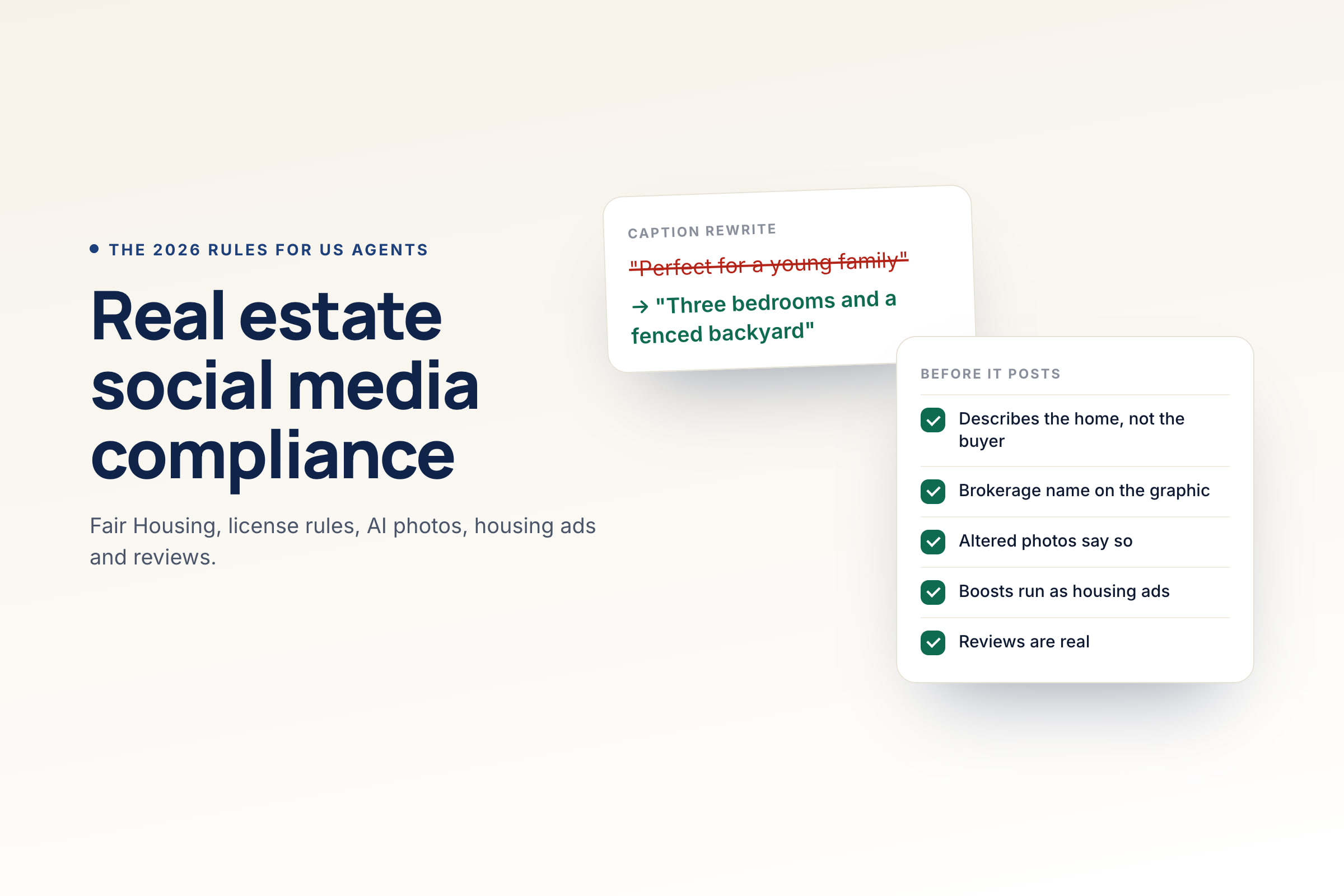
| The caption and images describe the home, not the ideal buyer | Fair Housing | 42 U.S.C. 3604(c) |
| Your brokerage name is on the profile and the graphic | State license law, NAR | SoP 12-5 |
| In California, your DRE license number is there too | California license law | 10 CCR 2773 |
| Altered photos say so and link to the original | California law, MLS rules | B&P 10140.8 |
| Boosted listing posts run in Meta's housing category | Meta policy | Meta Business Help |
| Another broker's listing has that broker's consent | MLS rules, NAR | Model MLS Rule 2.7 |
| A "Just Sold" post is for a sale you were part of | NAR | SoP 12-7 |
| Reviews are real and any incentive is disclosed | FTC | 16 CFR 465 |
| A co-branded ad with a lender is split at each party's share | RESPA | 12 U.S.C. 2607 |
| AI-drafted facts match the listing | Article 12, Fair Housing | NAR Code of Ethics |
The sections below explain each one.
Fair Housing rules for social media posts
What the law covers
The Fair Housing Act (42 U.S.C. 3604(c)) makes it illegal to publish any notice, statement or advertisement about the sale or rental of a home that indicates a preference, limitation or discrimination based on:
- race
- color
- religion
- sex
- disability
- familial status
- national origin
HUD's advertising rule, 24 CFR 100.75, spells out what that includes on social media. It covers "words, phrases, photographs, illustrations, symbols or forms", so a photo, an emoji or a hashtag can break the rule as easily as a sentence. It also covers "selecting media or locations for advertising" that keep part of the market from seeing it, which is why ad targeting matters.
The federal list is the minimum. NAR's Code of Ethics (Article 10 and Standard of Practice 10-3) adds sexual orientation and gender identity for REALTORS®, and many states and cities protect more classes, such as age, source of income or marital status. Write as if all of them apply.
Caption rewrites
The rule of thumb: describe the property, never the buyer. Most violations on social media are an adjective about people where an adjective about the house should be.
| Risky wording | Why it's a problem | Say this instead |
|---|---|---|
| "Perfect for a young family" | Familial status | "Three bedrooms and a fenced backyard" |
| "Ideal for empty nesters" | Familial status, and age in many states | "Single-level living with a primary suite on the main floor" |
| "Great for a professional couple" | Familial status | "Home office with its own entrance" |
| "Safe, quiet neighborhood" | Can signal who lives there | "Cul-de-sac street, 0.3 miles to Riverside Park" |
| "Walking distance to St. Mark's, great church community" | Religion | "0.4 miles to downtown, with shops and restaurants" |
| "Not suitable for wheelchairs" | Disability | "Second-floor unit, stairs only" |
| "Exclusive, private enclave" | Can signal exclusion | "Gated community with 24 homes" |
| "#BachelorPad" | Sex, familial status | "#DowntownCondo" |
Describing distances and features is fine. HUD's 1995 advertising guidance treats phrases like "family room", "great view" and "walk to bus stop" as descriptions of the property, not of who should buy it, and naming a nearby school with its distance is a fact about the home. Photos are covered too: a series of lifestyle images that only ever show one kind of person sends a message the caption doesn't.
What happened to HUD's 2024 digital ad guidance
In April 2024, HUD published guidance on how the Fair Housing Act applies to ads on digital platforms. HUD withdrew it with effect from September 17, 2025, in a Federal Register notice published on April 6, 2026. Articles and AI summaries still cite it, so don't rely on it. The withdrawal didn't change the law: the statute and 24 CFR 100.75 still apply to every post and ad.
The Equal Housing Opportunity logo is a similar case. It is required in HUD-assisted housing marketing, not for private brokers under federal rules, but many brokerages require it. Use it if your broker does.
Boosted posts and ads: the housing ad category
A boosted post is an ad. When you boost a listing post or run an ad for it on Facebook or Instagram, Meta requires you to turn on its housing Special Ad Category if you are a US advertiser or your audience is in the US, Canada or certain European countries. If you skip it, "your ad may be rejected".
Meta counts these as housing ads: sale and rental listings, mortgages and home equity loans, homeowners and renters insurance, and "property and house hunting services". General home-buying tips and fair housing education are not. A boosted "5 things to know before your first offer" post doesn't need the category, but a boosted listing does.
Under the housing category, Meta limits targeting as follows, as of September 2026:
- Location: country, region, county or city, but not ZIP code, and you can't exclude locations. A city, address or pin target in the US expands to a 15-mile radius.
- Age: fixed at 18 to 65+.
- Gender: every ad reaches all genders.
- Interests: some demographic, behavior and interest options are unavailable, and you can't exclude any.
- Lookalikes: Advantage+ lookalike audiences are unavailable. The older "Special Ad Audiences" were shut down in 2022 under Meta's settlement with the Justice Department, so any course that recommends them is out of date.
These limits exist because of the media-selection part of 24 CFR 100.75: choosing an audience that excludes a protected group is a Fair Housing problem, whoever built the targeting tool. Plan housing ads around a county or city and good content, and use our guide on promoting a listing on social media for the organic side.
Brokerage name and license number on social media
Do real estate agents need their license number on social media? Among the states we checked, only California requires it. Every one of them requires your brokerage name, and NAR's Code of Ethics requires it for REALTORS® everywhere.
NAR Article 12 and Standard of Practice 12-5
Article 12 of the NAR Code of Ethics requires REALTORS® to present a true picture in their advertising and to make their status as real estate professionals readily apparent. Standard of Practice 12-5 requires the firm name in any medium, "in a reasonable and readily apparent manner either in the advertisement or in electronic advertising via a link to a display with all required disclosures". That last part is NAR's one-click option: on social media, a clear link to a page with your disclosures can satisfy the Code, though your state may ask for more.
Standard 12-9, which requires the firm name and state of licensure, applies to firm websites, not to an agent's social profile.
State rules, checked September 2026
| State | Rule | Brokerage name | License number | On a profile or one link away? |
|---|---|---|---|---|
| California | B&P 10140.6, 10 CCR 2773 | Responsible broker's name | Yes, your eight-digit DRE number | Not addressed |
| Texas | 22 TAC 535.155 | Broker's name, at least half the size of the largest agent or team contact | No | Yes, on the profile page or one direct link away |
| Florida | 61J2-10.025 | Licensed name of the brokerage, next to the contact information online | No | Not addressed |
| New York | 19 NYCRR 175.25 | Broker or brokerage name, plus address or phone | No | Not addressed |
| Illinois | 68 IAC 1450.715 | Sponsoring broker's name, at least as large as the agent or team name | No | Not addressed |
A few details that trip agents up:
- California requires the license number and the responsible broker's name on "first point of contact" materials, including websites you control and ads in electronic media. The regulation never says "social media", but a profile you control and a paid ad fit its wording, so the safe reading is to put both on your profiles and paid social ads, in type no smaller than the smallest type you use.
- Texas defines advertising to include social media and lets the required information sit on your profile page or one direct link away, if it is readily noticeable. Business websites also need links to the TREC Consumer Protection Notice and the Information About Brokerage Services form.
- New York requires the correct license type. "Licensed sales agent" and plain "broker" are not allowed, so use your exact title, such as "Licensed Real Estate Salesperson".
- Illinois bans usernames and social media handles that deceptively divert traffic, so a handle that sounds like a different brokerage or a public agency is a problem.
If your state isn't here, search your regulator's site for its advertising rule. It is usually a single page, and most say whether social media is covered.
Team names
Team names are where brokerage names most often disappear. New York requires team names to include the word "team" and to appear with the brokerage name. Texas and Illinois tie the size of the broker's name to the team's: at least half as large in Texas, at least as large in Illinois. If your team has its own logo and handle, put the brokerage name in the bio and on every graphic, not only in the caption.
Where to put it on each platform
- Instagram: your bio, plus a small line on listing graphics and the last frame of a Reel. Instagram shortens captions in the feed, so the caption alone isn't enough.
- Facebook: your Page's intro and About section, plus the graphic.
- TikTok: your bio, plus an end card or on-screen text on listing videos.
- Paid ads: in the ad itself. Many people will never tap through to your profile.
Virtual staging, AI edits and AI images
California's altered-image law
Since January 1, 2026, California's Business and Professions Code 10140.8, added by AB 723, has required agents who use a digitally altered image in advertising for the sale of real property to include:
- a statement that the image has been altered, and
- a link, URL or QR code to a publicly accessible page that includes and clearly identifies the original, unaltered image.
"Altered" means adding, removing or changing elements with editing software or AI: furniture, fixtures, appliances, flooring, walls, paint color, landscaping, the facade, and views from the property. Routine edits are exempt: lighting, sharpening, white balance, color correction, straightening, cropping and exposure, as long as they don't change how the property is represented. On a website you control, the original has to be in the same posting. A willful violation of California's real estate law is a misdemeanor.
The law doesn't say how to do this on each platform. Here is one practical way to meet it:
- Carousel: put "Virtually staged" on the altered slide itself, put the original photo on the next slide, and add the link to the originals in your bio or caption.
- Reel: add a "Virtually staged" text overlay while the altered room is on screen, and put the link to the originals in the caption and your bio.
- Story: put the statement on the frame and add a link sticker to the originals.
- Graphics: a small QR code on the image works everywhere, including when someone screenshots the post.
Put the statement on the image, not only in the caption. People share and screenshot images without their captions.
Wisconsin from January 2027
From January 1, 2027, Wisconsin's 2025 Act 69 requires licensees to disclose in all advertising when it has been "altered or modified using technology, including artificial intelligence," to add, remove or change elements of the property in a way that creates a false or misleading impression. A similar bill in New York had not passed as of September 2026.
Everywhere else: NAR and your MLS
NAR's Standard of Practice 12-10 bans "misleading images", and Article 12 requires a true picture. Neither requires a label on every staged photo, whatever some vendor blogs say, and NAR wrote in August 2026 that the Code "does not specifically address AI photo disclosure". The stricter rules come from MLSs: NorthstarMLS in Minnesota, for example, announced in July 2026 that AI-edited and virtually staged photos must be clearly identified and shown with an unaltered image. Label altered photos wherever you are. It costs nothing and protects you from a buyer who feels misled at the showing.
Platform AI labels
The platforms have their own rules for AI-generated content:
- Meta requires you to use its AI label when you post a photorealistic video or realistic audio that was digitally created or altered, and may penalize you if you don't. Still images get an automatic "AI info" label when Meta detects AI signals in the file.
- TikTok requires creators to label AI-generated or significantly edited content showing realistic scenes or people, and may remove or restrict it otherwise. A virtually staged walkthrough video needs the label.
For more on video, see our real estate TikTok ideas.
AI-written captions: what to check before you post
No federal or state law requires you to disclose that AI wrote a caption, as of September 2026. The caption is still your advertising, so everything above applies to it, and AI gets some of it wrong in predictable ways.
AI is now normal in this job. NAR's 2026 REALTORS® Technology Report found that 56% of REALTORS® who use AI use it for social media posts. AI tools learned from millions of old listings, and old listings are full of "perfect for families" and "quiet, safe neighborhood". Check three things in every draft:
- Facts: beds, baths, square footage, price, HOA fees and school names match the listing. A wrong number in an AI draft is still a misrepresentation under Article 12.
- Fair Housing wording: nothing describes who should live there. Use the rewrite table above.
- Your voice: cut the adjectives with nothing behind them, like "stunning", "nestled" and "boasting", and put a fact in their place.
Some brokerages ask agents to add a line such as "Drafted with AI and reviewed by [agent name]". It isn't required anywhere yet. If your brokerage has an AI policy, follow it.
Reposting listings, Just Sold posts and coming soon
Posting another broker's listing
You need the listing broker's permission to advertise their listing. NAR's Model MLS Rule 2.7 says a listing "shall not be advertised by any Participant other than the listing broker without the prior consent of the listing broker", and Standard of Practice 12-4 bans advertising property without authority. IDX consent doesn't cover it: NAR's IDX policy authorizes IDX display on your websites, apps and audio devices, not on social media.
The photos are a separate question. They usually belong to the photographer or the listing brokerage, so consent to advertise the listing doesn't always include the right to post the photos. In New York, an ad for another broker's listing also needs wording like "Listing Courtesy of [broker]".
Can a buyer's agent post "Just Sold"?
Yes. Standard of Practice 12-7 lets REALTORS® who took part in the transaction as the listing broker or the cooperating (buyer's side) broker claim to have sold the property. Keep it accurate:
- Use your own photo, such as a closing-day shot with your clients' permission, or photos you have the right to use.
- Include your brokerage name.
- Don't suggest you had the listing. "Just helped my buyers close on their first home" is clearer than "Just sold!" over the listing photo.
- Before closing, only the listing broker's sold sign goes on the property, so a photo of you with a sign on the lawn has to wait.
Coming-soon posts
NAR's Clear Cooperation Policy requires the listing broker to submit a listing to the MLS within one business day of marketing it to the public, and public marketing includes "digital marketing on public facing websites". Treat a public "coming soon" post as starting that clock.
Since 2025, NAR's Multiple Listing Options for Sellers let a seller choose a delayed-marketing listing, which the listing broker can still promote, or an office exclusive, which can't be publicly marketed at all. Coming-soon rules are set by each local MLS, so check yours before you post.
Reviews and testimonials
The FTC's rule on consumer reviews and testimonials (16 CFR Part 465) has been in effect since October 21, 2024. For agents it means:
- No fake reviews. That includes writing one for a client, or having AI write one.
- No incentives tied to a positive review. A gift card for "a 5-star review" is out; a thank-you for any honest review is allowed but must be disclosed.
- Disclose insiders. A review from your spouse, your assistant or an agent on your team has to say so.
- No suppression. You can't threaten or pressure a client into removing a negative review.
- No bought followers or views. The rule bans buying fake social media influence.
The FTC's Endorsement Guides add the general duty: if there is a connection your audience wouldn't expect, such as a payment, a gift or a family tie, disclose it clearly. Knowing violations of the reviews rule can bring civil penalties, so share real reviews in the client's own words.
Co-marketing with lenders and title companies
Co-branded posts with a lender are common, and RESPA governs them. Section 8 of RESPA bans giving or accepting any "thing of value" for referrals of settlement service business, and the CFPB's Regulation X says marketing activities must not pay expenses that a referral source would otherwise pay itself.
In practice: when you and a lender run a co-branded ad or boost a joint post, each of you pays your own share, in proportion to the space or benefit each gets. If the lender covers your half, that payment can be a thing of value for referrals. Keep an invoice for each side. Marketing services agreements aren't banned outright, but the CFPB's RESPA FAQs say payments must be for real marketing services at a price reasonably related to their value. Talk to your broker before you sign one.
Build compliance into your templates
Most of this checklist is the same on every post, so set it up once instead of remembering it every time:
- A written policy. Who posts on the brokerage's behalf, what gets checked before publishing, and how long you keep copies of posts and ads.
- Fixed disclosures in your templates. Brokerage name, your license number where required, and the Equal Housing Opportunity logo if your broker uses it, on every graphic.
- A saved "Virtually staged" label and a link to your original photos, ready for any altered image.
- A review step before scheduling. Read every AI draft against the checklist above.
In Velisto, you enter your brokerage name and license number once in your brand kit, and they fill into every template you use, whether you are creating real estate content from a listing or from scratch. AI drafts are held for your review before anything is scheduled, so the final check stays with you.
Real estate social media compliance FAQ
Do real estate agents need their license number on Instagram? In California, yes: your eight-digit DRE number and your responsible broker's name belong on your profile and paid ads. Among the other states we checked (Texas, Florida, New York and Illinois), the license number isn't required, but the brokerage name is.
Does boosting a listing post count as a housing ad? Yes. Meta treats a boosted listing post as a housing ad and requires its housing Special Ad Category, which removes ZIP code, age and gender targeting. A boosted post with general home-buying tips doesn't need it.
Do I have to disclose that AI wrote my caption? Not under any US law as of September 2026. You are still responsible for what it says, so check the facts and the Fair Housing wording before posting, and follow your brokerage's AI policy if it has one.
Can I post another agent's listing on my page? Only with the listing broker's permission, under NAR's Model MLS Rule 2.7 and Standard of Practice 12-4. IDX consent covers your website and apps, not social media, and the photos may need separate permission.
Is it a Fair Housing violation to mention schools? No. Naming a school and its distance describes the property. Saying the home is "perfect for families" because of the school describes the buyer, and that is the problem.
For everything beyond the rules, from platforms to posting rhythm, read our complete guide to real estate social media marketing.
Set your brokerage name and license number once, and every template you use carries them. Get started.